
Guide to Cushing's Syndrome
Reviewed by the physicians of Columbia’s Adrenal Surgery Team, October 2024
About
Cushing's syndrome is a disease in which the body makes too much cortisol. Cortisol is a steroid that is made by the adrenal glands. Cortisol is necessary for daily life and helps the body respond to stressful events, regulates the sleep-wake cycles, and helps regulate the body's response to inflammation. A special part of the brain called the pituitary makes a hormone called adrenocorticotrophic hormone (ACTH) that controls the release of cortisol from the adrenal glands. Although cortisol is essential to life, constantly high levels of cortisol can damage the entire body.
The main causes of Cushing's syndrome are ACTH-dependent disease (when the body makes too much ACTH which in turn increases the cortisol production), ACTH-independent disease (when the adrenal is making too much cortisol and the ACTH is therefore low), and iatrogenic disease (when the patient is taking prescription steroids). Prescription steroids called glucocorticoids, like prednisone, are used to treat patients who had a transplant or who have diseases such as rheumatoid arthritis, asthma, or inflammatory bowel disease. Even if the patient is taking the right dose of steroid for their condition, they may develop Cushing's syndrome. ACTH-dependent and -independent disease can be caused by the following sources:
- ACTH-dependent disease:
- Pituitary Adenoma (also known as Cushing’s Disease)
In this condition, a small tumor causes increased ACTH production. Pituitary adenomas are the most common cause of Cushing's syndrome and makes up about 70% of cases. - Ectopic ACTH-producing Tumor
In this rare condition, a tumor outside of the pituitary is making too much ACTH. These tumors are most commonly found in the lung and thymus gland, but have also been found in the thyroid, ovary, adrenal gland, and liver.
- Pituitary Adenoma (also known as Cushing’s Disease)
- ACTH-independent Disease
- In this condition, either both adrenal glands are hyperactive or there is an adrenal tumor that is making too much cortisol. Adrenal tumors cause about 30% of cases of Cushing's Syndrome. Although most of these tumors are benign, they can rarely be adrenal cancers.
Signs and Symptoms
Cushing's Syndrome can affect many different organs in the body and causes a variety of symptoms:
Physical Signs
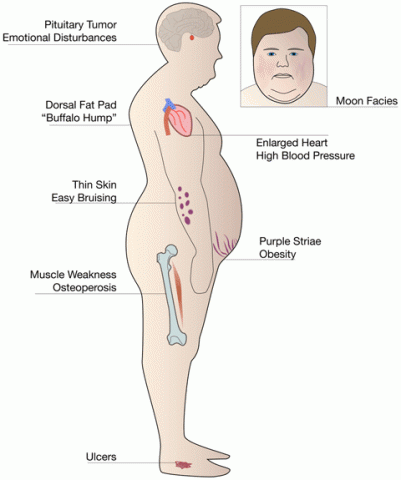
- "Moon face" – the face develops a rounded appearance
- Dorsal fat pad or "Buffalo hump" – a mound of fat forms at the base of the neck
- Weight gain – especially in the abdomen while the arms and legs become skinny
- Increased body hair – especially on the arms, face, and around the belly button
- Thinning skin
- Acne
- Easy bruising
- Leg swelling
- Purple stretch marks on the abdomen and legs
- Constantly rosy cheeks
Symptoms
- Diabetes – high blood sugar levels
- Hypertension – high blood pressure
- Mood changes – many patients feel "hyper" while others have sudden mood swings
- Muscle weakness
- Irregular menstrual cycles
It is important to note that while weight gain is commonly seen in Cushing's Syndrome, Cushing's Syndrome itself is a rare cause of weight gain. In addition, many of these symptoms are non-specific (i.e. can be caused by other problems other than Cushing's syndrome) and it does not necessarily mean that you have Cushing's Syndrome if you have these symptoms. Finally, some patients who have too much cortisol but none of the classic signs or symptoms may have what is known as subclinical Cushing's Syndrome and should be treated similarly to patients with classic Cushing's Syndrome.
Diagnosis
Patients with Cushing's Syndrome make too much cortisol and do not lower their cortisol levels after being given artificial steroid in pill form. There are a number of ways to see if a patient is making too much cortisol:
- Low dose dexamethasone suppression test - this test involves taking a pill containing 1mg of Dexamethasone (the artificial steroid) at 11PM and then checking the blood cortisol level at 8AM the next morning. If the level does not drop (i.e. does not suppress), this suggests excess cortisol secretion.
- 24 hour urine cortisol level – this test involves collecting a patient's urine for an entire day and measuring the overall cortisol level
- Salivary cortisol – this test involves swabbing the inside of the mouth with a special cotton swab before going to bed and measuring the cortisol level in the saliva
Localization
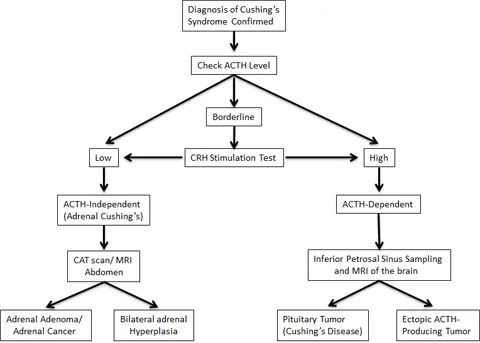
Once a diagnosis of Cushing's Syndrome is made, the next step if to figure out what is causing the problem—i.e. is it an adrenal tumor (adrenal Cushing's), a pituitary tumor (Cushing's disease), or a tumor elsewhere in the body (ectopic ACTH-producing tumor). A blood ACTH level will be done to help determine the cause. If the ACTH level is high or normal than the cause is either a pituitary tumor or ectopic ACTH-producing tumor. Typically a brain MRI will be done to see if there is a pituitary tumor. If this is negative, then a special test called inferior petrosal sinus sampling will be done. This test involves feeding a catheter into the veins that come from the pituitary gland through a small needle stick in the groin and measuring blood samples to see if there is increased production. If the ACTH level is low or suppressed, then the cause is an adrenal tumor and a CAT scan or MRI of the abdomen will be done to see if one or both adrenal glands are involved.
Treatment
Patients with Cushing's disease (i.e. a pituitary tumor) typically have benign tumors that are removed by a neurosurgeon. This operation is usually performed through the patient's nose in an operation called transsphenoidal surgery. In cases where surgery cannot cure the patient, other therapies like directed radiation treatment (i.e. Gamma Knife) may be successful. If surgery, radiation, and medications fail to control Cushing's disease, removal of both adrenal glands may be needed.
Patients with Cushing's syndrome caused by an adrenal tumor can usually be cured by removal of either one or both adrenal glands, depending on which adrenal glands are involved. Almost all of these operations can be done using minimally invasive techniques such as laparoscopy (i.e. making 3 or 4 very small incisions and using a small camera and special instruments). (See Adrenal Surgery) In Cushing's syndrome caused by one hyperactive adrenal gland, the other adrenal gland temporarily shuts down because the hyperactive gland is "doing all the work." It takes some time for this other gland to "wake up" and start making cortisol again. During and after the operation to remove one diseased adrenal gland, patients may receive extra steroids through the IV and pills until the other adrenal starts working again. This steroid dose will be slowly lowered over time until it can be stopped safely. Patients having both adrenal glands removed will also receive steroids in the operating room and will need steroid pills for the rest of their lives.
Next Steps
If you are dealing with an adrenal issue, our team at the Columbia Adrenal Center is here to help. Call (212) 305-0444 or request an appointment online.
Related
- About the Adrenal Glands
- Adrenal Cancer
- Adrenal Incidentaloma
- Metastatic Disease to the Adrenal Gland
- Paraganglioma
- Pheochromocytoma
- Primary Hyperaldosteronism (Conn's Syndrome)
- Sex-hormone Producing Tumor
- Adrenal Surgery
This content has been created by Columbia’s Health Guide Team. Learn more about our efforts to bring you the clearest, most accurate, and most human health resources available.